Maple syrup labels can look deceptively simple. A bottle may say Golden, Amber, Dark or Very Dark, often followed by a taste description such as Delicate, Rich, Robust or Strong. The easy mistake is to read those words as a quality ranking: light must be premium, dark must be lower grade.
That is not how the current Canadian and U.S. Grade A systems work.
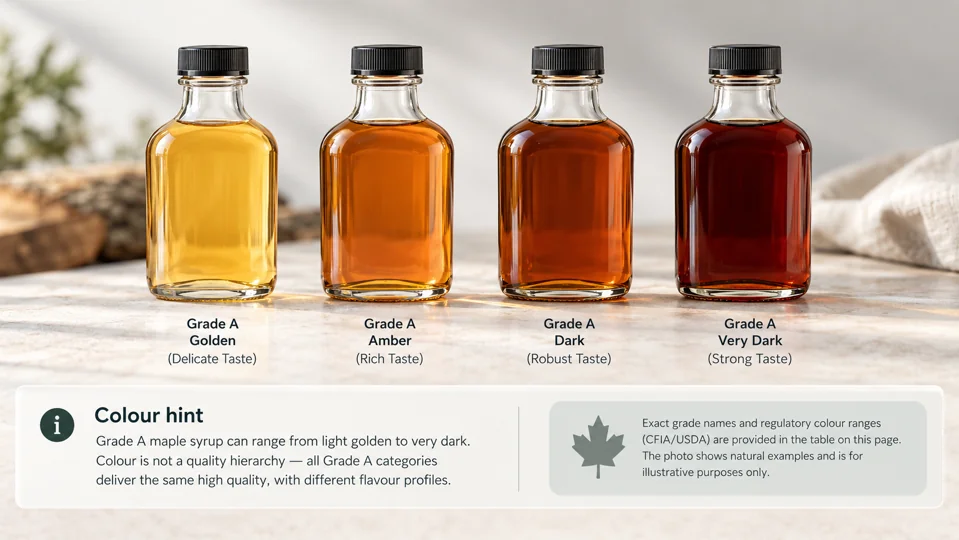
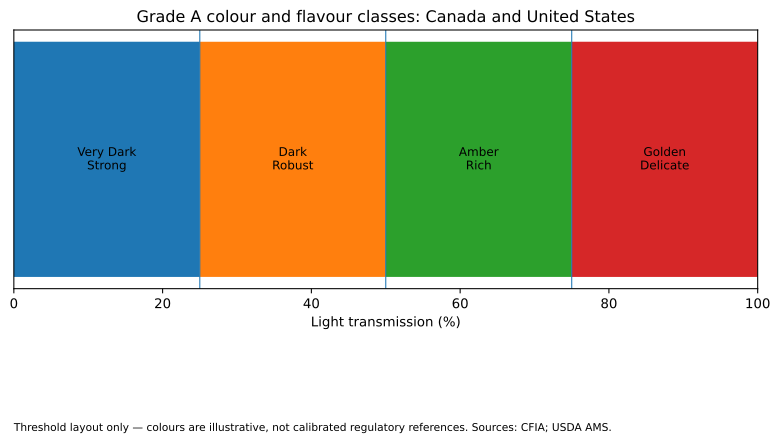
All four colour classes can be Grade A. The colour category tells you where the syrup falls on an official light-transmission scale and pairs that range with a taste descriptor. It does not place Golden above Dark in a best-to-worst hierarchy. [1][4]
For consumers, the most useful idea is therefore simple: grade tells you whether a syrup meets defined quality requirements; colour class helps describe its colour and expected intensity of maple taste.
The short answer: what do the four classes mean?
Canada and the United States use closely aligned modern Grade A colour/flavour classes. [1][4]
| Grade A colour class | Official taste descriptor | Light transmission |
|---|---|---|
| Golden | Delicate | >=75.0% |
| Amber | Rich | 50.0% to <75.0% |
| Dark | Robust | 25.0% to <50.0% |
| Very Dark | Strong | <25.0% |
A higher percentage means more light passes through the syrup under the specified measurement method. Golden is therefore the lightest of the four classes and Very Dark the darkest.
The important point is what the table does not say. It does not say that Golden is better than Amber, that Amber is better than Dark, or that Very Dark has fallen outside Grade A. [1][4]
Grade A colour and flavour classes
Grade A is more than a colour
Colour attracts attention because it is easy to see, but a grading standard is not simply a colour chart.
Under Canada's Grade Compendium, Canada Grade A syrup must have a soluble-solids content between 66.0% and 68.9%, be free from fermentation, have uniform colour, be free from sediment, cloudiness and turbidity, have a colour class, and possess a maple flavour characteristic of that class without objectionable odour or taste. [1]
The U.S. Grade A standard likewise includes requirements beyond colour. USDA describes Grade A maple syrup as having no more than 68.9% solids by weight, good uniform colour, good flavour and odour with maple intensity appropriate to the colour class, no damaging off-flavours or odours, and a clean appearance free from cloudiness, turbidity and sediment. [3][4]
The exact regulatory frameworks are separate, and their wording is not identical. But for a shopper, the shared principle is clear: Grade A is a quality classification with colour/flavour subcategories, not a contest to produce the palest syrup possible.
How is maple syrup colour actually measured?
The official categories are based on light transmission. Canada specifies measurement using a spectrophotometer with a 10 mm light path at a wavelength of 560 nanometres, comparing the result with a reference fixed at 100% transmission; an approved visual glass comparator with corresponding optical specifications may also be used. [1]
The U.S. standard uses the same core spectrophotometric concept: a 10 mm light path at 560 nm, with equivalent-result methods also allowed. [4]
This matters because an official colour class is not simply someone's visual opinion. It is tied to a defined measurement.
It also means consumers should not try to recreate the official test by comparing bottles in a kitchen window. Bottle colour, glass thickness, label coverage, lighting, viewing angle and the volume of syrup in the container can all affect what you think you see. A bottle can help you form an impression; it is not a calibrated grading instrument.
A style for your taste.
All four classes can be Grade A. Open a class to explore its official descriptor.
Illustrative colours, not calibrated grade references. These are flavour-selection cues, not a best-to-worst ranking.
Explore the grading standards →Golden, Delicate Taste
Golden is the lightest Grade A colour class. Under both the Canadian and U.S. thresholds used here, it transmits at least 75.0% of light in the official test. Its paired taste descriptor is Delicate. [1][4]
For consumers who prefer a lighter maple expression, the word "Delicate" is the useful cue. It describes the official flavour class; it does not mean the syrup is more pure, more natural or more carefully made than darker Grade A syrup.
Editorial use suggestion: Golden can be attractive where a lighter maple profile is wanted and where the syrup should not dominate other flavours. This is a culinary suggestion, not a grading rule.
Amber, Rich Taste
Amber covers syrup with light transmission from 50.0% to below 75.0%. Its official taste descriptor is Rich. [1][4]
For many shoppers, Amber may look like the visual middle ground between very light and very dark syrup. But "middle" should not be confused with a universal standard of balance or quality. The grading system tells you its colour range and associated taste descriptor; personal preference does the rest.
Editorial use suggestion: Amber is a versatile starting point for table use, breakfast foods, desserts and general cooking when a recognisable but not necessarily strongest maple note is desired.
Dark, Robust Taste
Dark transmits from 25.0% to below 50.0% of light and carries the taste descriptor Robust. [1][4]
This class is especially useful for correcting one of the most persistent consumer misunderstandings: Dark does not mean defective or second-rate. A syrup can be Dark and still meet the full requirements of Grade A.
The word "Robust" should be read as a flavour-intensity cue, not as a warning label.
Editorial use suggestion: Dark can work well when a more pronounced maple character is wanted in glazes, sauces, baking or savoury cooking. It can also simply be the preferred table syrup of someone who likes a stronger maple taste.
Very Dark, Strong Taste
Very Dark is the darkest Grade A class, with light transmission below 25.0%. Its official taste descriptor is Strong. [1][4]
Again, "Very Dark" does not mean "below Grade A". If it is sold as Grade A under the relevant system, it has met the applicable Grade A quality requirements as well as falling within this colour range.
Editorial use suggestion: Very Dark is particularly useful when a strong maple presence is desired, including recipes where subtler syrup could disappear behind other ingredients. But there is no rule preventing someone from pouring it over pancakes or yoghurt if that is the flavour they enjoy.
Is darker maple syrup lower quality?
Under the current Canadian and U.S. Grade A systems, the answer is no. [1][4]
Dark and Very Dark are explicitly part of the Grade A framework. Colour therefore cannot be used on its own to create a quality ladder from Golden at the top to Very Dark at the bottom.
That distinction is important because older terminology and long-standing consumer assumptions can linger even after grading systems change. The present MapleSyrup.eu research package is strong enough to explain the current standards, but it does not yet contain the equally strong historical source chain needed to tell a definitive story about exactly when and why darker syrup acquired a lower-quality reputation in every market.
For V1, the responsible position is to correct the current misconception without inventing a historical explanation.
Are Canadian and U.S. grades different?
They are separate national frameworks, but their modern Grade A colour/flavour classes are strikingly similar.
Both use:
- Golden - Delicate
- Amber - Rich
- Dark - Robust
- Very Dark - Strong
And the light-transmission boundaries used for those four classes are closely aligned. [1][4]
There are still jurisdictional differences in how standards are administered, how grade names are applied and how other regulatory rules interact with the product. MapleSyrup.eu therefore should not collapse the Canadian and U.S. systems into one imaginary international law.
But neither should consumers be given the impression that a Canadian Amber and a U.S. Amber belong to fundamentally different modern colour scales. For this specific part of grading, the systems are much more similar than many origin-based comparisons imply.
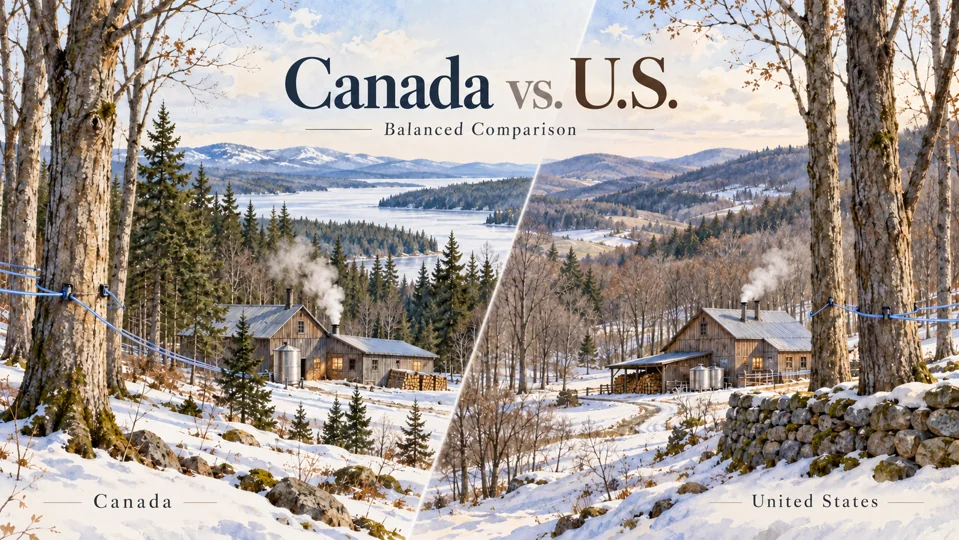
For a broader national comparison, see Canada vs U.S. Maple Syrup.
What is Processing Grade?
Both systems distinguish consumer-oriented Grade A from syrup intended for processing, although the legal details differ.
Canada recognises Canada Processing Grade for syrup that meets the specified soluble-solids range but does not meet all of the Grade A requirements relating to colour uniformity/clarity, colour class and characteristic flavour/odour. [1]
USDA likewise defines Processing Grade for syrup that does not meet Grade A requirements but meets processing-grade requirements for use in manufacturing other products. USDA's public standard also places restrictions on packing Processing Grade in consumer-size retail containers. [3]
For ordinary European consumers comparing retail bottles, the key lesson is not to memorise processing law. It is to understand that Grade A and its four colour classes are a specific consumer-facing quality framework; darker colour does not itself push syrup into Processing Grade.
Does colour tell you exactly what a syrup will taste like?
Colour class provides a useful, standardised clue. The official descriptors deliberately pair lighter syrup with Delicate and progressively darker classes with Rich, Robust and Strong maple taste. [1][4]
But a descriptor is not a complete sensory biography of a bottle. The standards do not say that every Golden syrup will taste identical, or that every Dark syrup will produce exactly the same tasting notes.
That is why MapleSyrup.eu should use colour class as a selection guide, not as a promise of one precise flavour profile.
Which maple syrup colour should you buy?
There is no universally correct answer. If the product meets Grade A requirements, the choice can reasonably be guided by the flavour intensity you want.
A simple consumer shorthand is:
| If you want... | A useful class to explore |
|---|---|
| A lighter maple profile | Golden / Delicate |
| A fuller but broadly versatile profile | Amber / Rich |
| A stronger maple presence | Dark / Robust |
| The strongest official Grade A descriptor | Very Dark / Strong |
This table is editorial guidance, not a legal or culinary rule. A person who loves strong maple flavour may prefer Very Dark on breakfast foods; another may use Golden in baking. The grading system does not dictate the "correct" recipe for each class.
What should European buyers look for on a bottle?
For a shopper in Europe, colour grade is only one part of the label.
Check:
- whether the product is genuine maple syrup rather than a maple-flavoured table syrup;
- the stated grade/colour class where applicable;
- the country or region of origin;
- ingredient and food-information details;
- organic or other certification claims where relevant;
- the flavour intensity you actually want.
Do not treat national origin as a substitute for the grade. Canadian syrup is not automatically lighter, darker or better than U.S. syrup, and Vermont origin does not create a separate quality scale.
The dedicated Maple Syrup Buying Guide will bring those label questions together.
The evidence-based takeaway
Modern maple grading is easier to understand once two concepts are separated.
Grade A is a quality classification with requirements that go beyond colour. Golden, Amber, Dark and Very Dark are colour classes within Grade A, paired with the official taste descriptors Delicate, Rich, Robust and Strong. [1][3][4]
In both Canada and the United States, the four colour ranges are closely aligned. Dark and Very Dark can be fully Grade A. A lighter syrup is therefore not automatically "better", and a darker syrup is not automatically lower quality.
For consumers, the practical question is not "Which colour is best?" It is which flavour intensity suits you and the way you plan to use the syrup.
That is the distinction MapleSyrup.eu should keep visible throughout its buying and origin coverage: colour is information; it is not a quality hierarchy.
Sources & reading notes
Numbered references belong to this article. Dates, definitions and limitations matter.
- Canadian Food Inspection Agency
Canadian Grade Compendium: Volume 7 - Maple Syrup ↗Current checked 10 Sep 2026 · Grade names and colour classes.
- USDA Agricultural Marketing Service
Maple Syrup Grades & Standards ↗Current page checked 10 Sep 2026 · Federal Grade A framework and Processing Grade overview.
- USDA Agricultural Marketing Service
United States Standards for Grades of Maple Syrup ↗Current standard used in dossier · US Grade A colour and flavour classes.
Download the complete source register (CSV) ↓ · Our methodology