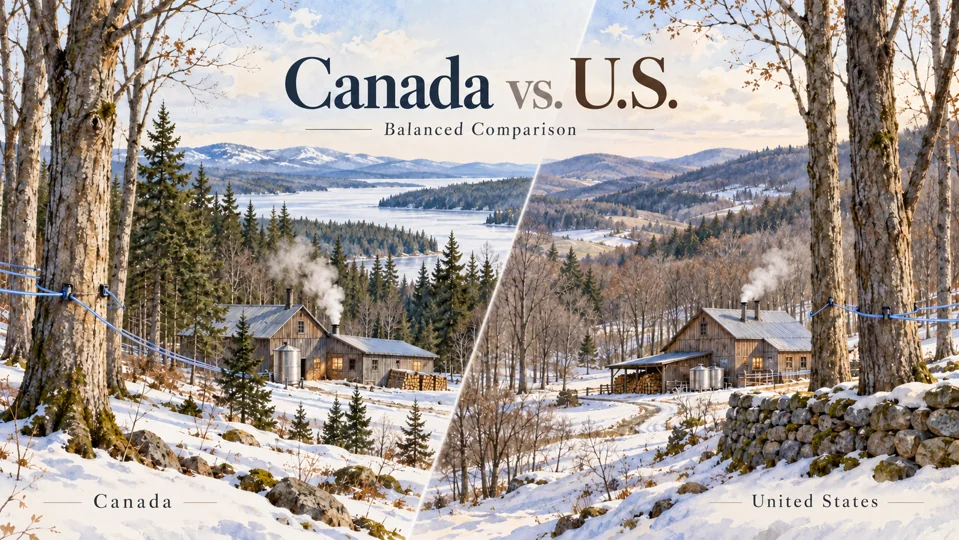
Canada and the United States both produce genuine maple syrup on a substantial commercial scale. The clearest difference is size: Canada produces far more, with Québec at the centre of the Canadian industry, while Vermont is the leading US state. But scale is not the same thing as quality, and nationality is not a grade.
For European consumers, there is another important difference. Canadian-origin goods overwhelmingly dominate recorded extra-EU imports in the customs category covering maple sugar and maple syrup. US-origin volumes are much smaller. That is strong evidence about supply. It is not evidence that European shoppers consciously prefer Canada to Vermont or other US origins.
The useful comparison is therefore not "Which country is best?" It is: what differs in production, regional concentration, grading and European supply - and which popular claims go beyond the evidence?
The short answer
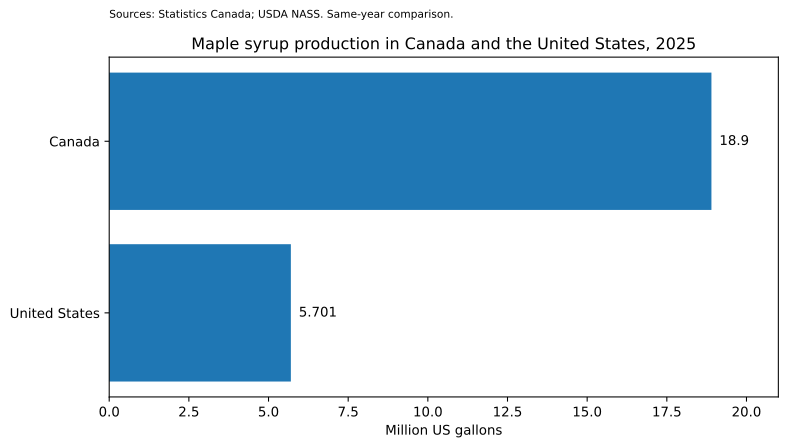
In 2025, Canada produced 18.9 million US gallons of maple syrup, compared with 5.701 million gallons in the United States. Using those two official national figures, Canadian production was a little more than three times the US volume. Québec produced about nine-tenths of the Canadian total. [1][2]
Vermont, meanwhile, dominates the US industry. USDA data for 2026 put Vermont at 3.091 million gallons out of 5.877 million nationally, or about 52.6%. [2]
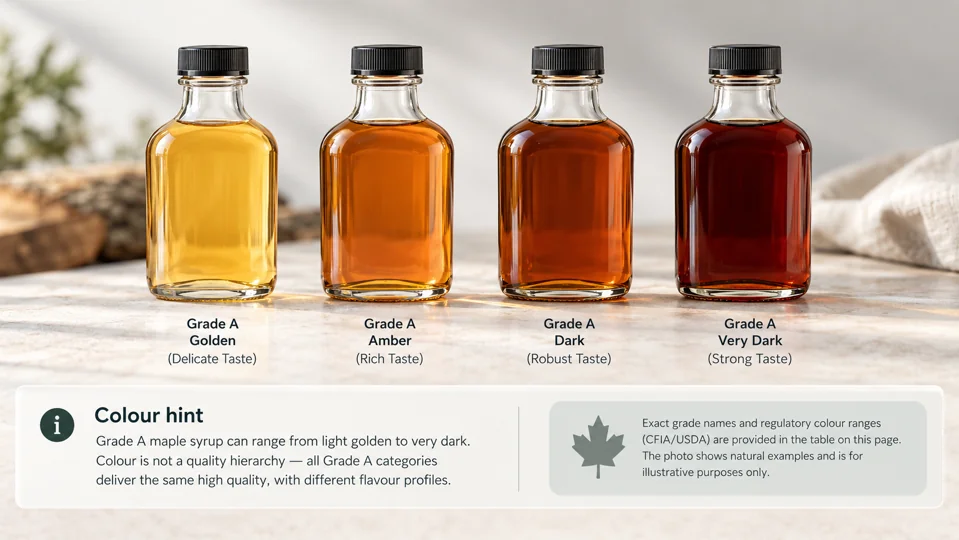
The countries use different regulatory frameworks, but their modern Grade A colour and flavour categories are closely aligned: Golden/Delicate, Amber/Rich, Dark/Robust and Very Dark/Strong. Darker syrup is not automatically lower quality. Dark and Very Dark can both be Grade A when the other requirements are met. [3][4]
So there are real differences in scale and industry geography, but the evidence does not establish a national quality winner.
Canada and the United States · 2025
Canada produces much more maple syrup than the United States
A fair production comparison should use the same crop year. Statistics Canada reported 18.9 million US gallons for Canada in 2025; USDA NASS reported 5.701 million gallons for the United States in the same year. [1][2]
Canada therefore represented about 76.8% of the combined Canada-plus-US production reported in those two national datasets. That figure is useful for comparing the two countries, but it is not a world-market share because the denominator contains only Canada and the United States.
The simpler consumer takeaway is more robust: in 2025 Canada produced a little more than three times as much maple syrup as the United States. That difference helps explain Canada's much larger export presence, but it does not tell us that an individual Canadian bottle is better than an individual US bottle.
Québec and Vermont dominate their respective industries
Canada's production is highly concentrated in Québec. The foundation research reports 17.0 million gallons from Québec out of 18.9 million for Canada in 2025. Because those published figures are rounded, the most appropriate consumer wording is that Québec produced about 90% of Canada's maple syrup that year. [1]
That does not mean all Canadian maple syrup comes from Québec. New Brunswick, Ontario and Nova Scotia also have documented production, although on a much smaller scale in the current national picture.
In the United States, Vermont is the dominant state. USDA's 2026 figures report 3.091 million gallons from Vermont out of 5.877 million nationally, about 52.6%. New York and Maine are also major producers, alongside several other northern states. [2]
This is why Canada-versus-Vermont comparisons appear so often: Québec and Vermont are the most prominent production centres within their respective countries. They should not, however, be treated as equivalent units. Québec is a Canadian province that accounts for roughly nine-tenths of Canadian production, while Vermont accounts for just over half of US production in the 2026 USDA data.
Are Canadian and US maple syrup grades different?
They are administered under different national systems, but their modern Grade A colour and flavour structures are remarkably similar. Both use four principal consumer-facing classes: Golden with a Delicate taste, Amber with a Rich taste, Dark with a Robust taste and Very Dark with a Strong taste. [3][4]
The colour bands are also closely aligned around the same light-transmission thresholds: Golden at 75% or more; Amber from 50% to below 75%; Dark from 25% to below 50%; and Very Dark below 25%. The underlying legal and inspection documents are separate, but the modern consumer-facing colour/flavour framework is substantially harmonised. [3][4]
That matters because colour is often mistaken for a simple quality ladder. Under the current systems, Dark and Very Dark can still be Grade A. A darker syrup is better understood as a different colour and flavour profile, not automatically as a lower grade.
More similar than different: Both systems use Golden/Delicate, Amber/Rich, Dark/Robust and Very Dark/Strong Grade A classes.
Does Canadian maple syrup taste better?
The project research does not support a national winner. It found no robust comparative evidence establishing that Canadian maple syrup is inherently better-tasting than Vermont or other US maple syrup, or vice versa.
Official grading gives a more useful way to discuss flavour than nationality. The recognised spectrum runs from delicate through rich and robust to strong maple character. Two syrups from different origins may therefore be more meaningfully compared by their individual grade, sensory profile and product characteristics than by the flag on the label.
The same caution applies to production stereotypes. The research does not provide representative comparative evidence for a simple "Vermont is artisanal, Canada is industrial" divide. Regional identity and production scale are real subjects; they are not shortcuts to a quality verdict.
EU extra-EU supply by origin · 2024
Why does Canada dominate recorded European import supply?
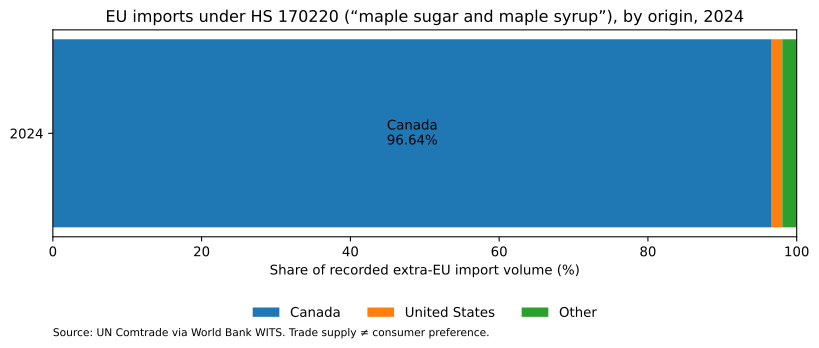
The supply-side difference is striking. In 2024, recorded extra-EU imports under HS 170220 totalled about 12.906 million kilograms. Canada accounted for 12.473 million kilograms, or 96.64% of that volume. The United States accounted for 184,055 kilograms, or 1.43%. [8]
There is an important customs caveat. HS 170220 is defined as maple sugar and maple syrup. The EU nomenclature does not provide a perfectly clean statistical category for ordinary maple syrup alone, so these figures should not be described as exact syrup-only market shares. [5][6]
Even with that limitation, the trade pattern is clear: Canada is overwhelmingly the principal recorded extra-EU origin in this maple customs category, while direct US-origin volumes are much smaller. Germany is one of the important European trade markets. In 2025, Germany represented 6.8% of Canadian maple-product export volume and 7.2% of Canadian export value. [7]
Those figures describe supply chains, not consumer psychology. Imports may feed inventories, food manufacturing, wholesale, retail, hospitality or re-exports, and products can be redistributed within the EU after entry. Trade data therefore cannot tell us what percentage of European households buy maple syrup, what shoppers see on a particular shelf, or which origin they prefer.
Do Europeans prefer Canadian maple syrup?
Current evidence does not establish that they do. A targeted launch-oriented review for MapleSyrup.eu found no sufficiently robust direct European maple-specific study comparing Canadian origin with Vermont or other US origins in a representative survey, controlled choice experiment or willingness-to-pay design.
That is different from saying origin never matters. A 2023 systematic review by John Thøgersen found substantial evidence that country-of-origin information can influence food evaluation and choice. But origin is only one cue among several, and the broader European literature often includes domestic or local preferences. General country-of-origin research therefore supports the proposition that origin can matter; it does not establish that Canada is preferred for maple syrup. [9]
The evidence picture is asymmetric. Canada's commercial supply presence in Europe is directly measurable, and Canadian promotional activity in markets including Germany and the UK is documented. What has not been measured well enough is the behavioural bridge: whether European maple buyers perceive Canadian origin as more authentic, higher quality or worth paying more for than Vermont origin. [7][11]
What does Vermont consumer research tell us?
There is stronger maple-specific origin research in North America, but it must stay in its geographic context. A market study prepared for the Vermont Agency of Agriculture surveyed 1,802 respondents across nine Northeastern US states in 2020-21. Geographic origin mattered to many respondents, and Vermont origin could carry value within that market. [10]
The study is useful because it shows that regional origin can matter in an established maple-producing market. It is also commissioned market-development research based on a regional US sample, and some of its stated willingness-to-pay results were strongly skewed. It cannot tell us how Europeans value Vermont - or whether they recognise it as a maple origin at all.
The responsible conclusion is limited but useful: Vermont has a strong regional maple identity in the Northeastern US evidence base; European recognition and valuation of Vermont remain insufficiently measured.
Evidence note: Canada-US trade tensions, reviewed September 2026
The current political and trade context is relevant to the CBC story that helped prompt this project, but no maple-specific European causal effect has been established. The targeted review did not locate representative consumer data, retailer scanner evidence or assortment studies showing European buyers switching from US or Vermont maple syrup to Canadian syrup because of current Canada-US tensions.
Canada's strong commercial position in Germany also predates the present dispute. The research records substantial Canadian maple-product exports to Germany in 2021 and 2022, before the current confrontation. That makes a simple claim that recent politics created Canada's European prominence especially difficult to defend. [7]
A smaller effect cannot be ruled out; it simply has not been measured well enough to state as fact. This section should be re-checked or removed when the current political context is no longer editorially relevant.
What should a European buyer take from the comparison?
Origin can be meaningful if you want to understand where a syrup was produced or support a particular region. But origin should not replace product-level information.
A practical comparison starts with whether the product is genuine maple syrup rather than a maple-flavoured table syrup. From there, consider the declared origin, Grade A colour/flavour class, any certification relevant to you, price and intended use. A Golden/Delicate syrup and a Dark/Robust syrup represent different sensory profiles; they are not Canadian-versus-American quality levels.
Canada deserves major attention because of its production scale and its dominant measured role in European import supply. Vermont deserves serious attention because it is the leading US producer and has a well-documented regional identity in North American maple research. The evidence does not require a winner.
For purchasing details, this page should link to the Maple Syrup Buying Guide and to the full Grades, Colour & Taste guide.
Key takeaway
Canada and the United States both have established maple-syrup industries. Canada is much larger in production; Québec accounts for about nine-tenths of the Canadian total, while Vermont accounts for just over half of US production in the latest USDA state data used here. Their modern Grade A colour/flavour systems are closely aligned, so nationality is not a grading hierarchy.
In Europe, Canadian origin overwhelmingly dominates recorded extra-EU imports in the combined customs category for maple sugar and maple syrup. That supply dominance is clear. What current evidence does not establish is that European consumers consciously prefer Canadian maple syrup over Vermont or other US syrup. Keeping those two findings separate is the basis of an evidence-led comparison.
Sources & reading notes
Numbered references belong to this article. Dates, definitions and limitations matter.
- Statistics Canada
The Daily - Maple products, 2025 ↗2025 crop; corrected 16 Dec 2025 · Corrected 2025 production and annual change.
- USDA National Agricultural Statistics Service
Crop Production, June 2026 ↗2025 national / 2026 state data used · US production; Vermont 2026 production.
- Canadian Food Inspection Agency
Canadian Grade Compendium: Volume 7 - Maple Syrup ↗Current checked 10 Sep 2026 · Grade names and colour classes.
- USDA Agricultural Marketing Service
United States Standards for Grades of Maple Syrup ↗Current standard used in dossier · US Grade A colour and flavour classes.
- Eurostat
User manual on international trade in goods statistics - 2026 edition ↗2026 · Origin vs consignment and trade methodology.
- Agriculture and Agri-Food Canada
Statistical overview of the Canadian maple industry, 2025 ↗2025 data; published 2026 · Canadian exports; Germany volume/value shares.
- UN Comtrade via World Bank WITS
HS 170220 trade data ↗2020-2024 series; 2024 used here · EU extra-EU origin shares.
- John Thøgersen
How does origin labelling on food packaging influence consumer product evaluation and choices? A systematic literature review ↗2023 · General country-of-origin mechanism; not maple-specific.
- Atlantic Corporation / Vermont Agency of Agriculture, Food and Markets
Identifying Market Opportunities for Vermont Maple Syrup Producers ↗Survey 2020-21 · Vermont origin preferences; contextual only.
- Agriculture and Agri-Food Canada
Minister MacAulay announces new funding to help promote Canadian maple syrup around the world ↗29 Apr 2024 · Promotion activity; not campaign effectiveness.
Download the complete source register (CSV) ↓ · Our methodology